
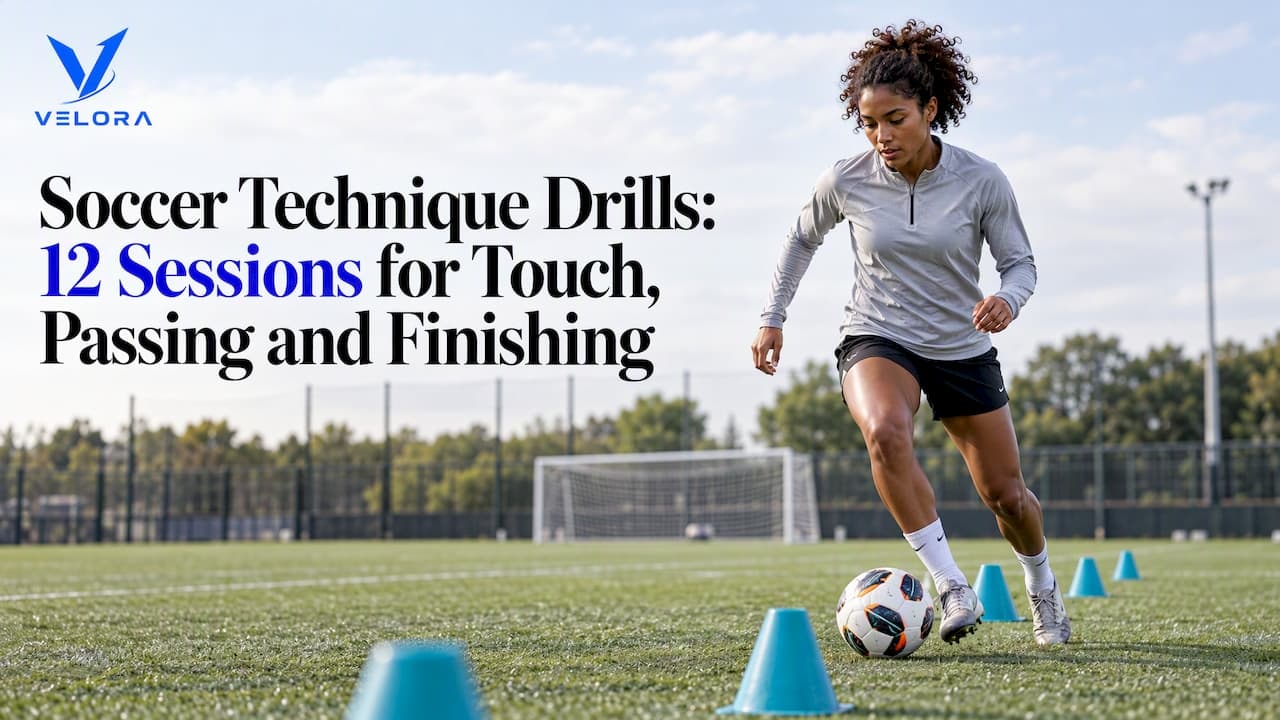
The best soccer technique drills are short, repeatable and built around one skill at a time: close control, dribbling, passing, receiving or finishing. Start with no opponent, add pressure only once the movement is clean, then test it in a small game. This guide gives you twelve drills with setups, coaching points and ways to make each one easier or harder, plus a plan for practicing alone and a way to measure whether you are improving.
TL;DR
- Train one technical skill per block, unopposed first, then with a passive defender, then in a small-sided game.
- Ten clean touches in a row mean more than one flashy one. Count quality reps, not total reps.
- You need a ball, a few cones and a wall to train alone. Space and teammates are not required for most touch work.
- Scale difficulty with constraints (foot surface, touch limits, space, defenders) instead of inventing new drills.
- Film a short set every week and compare it with the last one. That is how you see progress.
Table of Contents
- How to use these drills
- Ball control and dribbling drills
- Passing and receiving drills
- Shooting and finishing drills
- Small-sided games: where technique meets pressure
- Adapting drills by age and level
- Practicing technique alone or at home
- How to structure and measure progress
- Our perspective: feedback is the missing piece
- Get coach-style feedback on your technique
- FAQ
- Sources
How to use these drills
Technique is the ability to do the same thing correctly again and again: receive the ball where you want it, pass it at the right weight, strike it cleanly. Tactics decide what to do. Technique decides whether you can do it.
Four rules make the drills below work for any age:
- Start unopposed. Coach Rob Ellis makes the same point about dribbling in The Soccer Coach's Toolkit: begin with little outside stimulus, then add tricks, 1v1s and small-group play.
- Use both feet. Every drill should be done with the weaker foot as often as the stronger one.
- Keep sessions short. Ten to fifteen minutes per drill, with a rest in between, beats one long grind.
- Change one variable at a time. Add a defender, or shrink the grid, or limit touches. Not all three at once.
Ball control and dribbling drills
Close control is the base for everything else. If you want more sessions on this topic alone, our guide to football dribbling drills goes deeper.
1. Free dribbling in a grid
FIFA's Mastering ball control session uses two 15×15 m areas with one ball per player. Players work through close-control variations: switching the ball between the inside of each foot, rolling it with the sole, juggling, Cruyff turns and controlling balls out of the air.
How to run it: Mark a 15×15 m square (about 50×50 feet). Each player has a ball and dribbles freely, head up, changing direction every few touches. Call a new skill every 30 seconds.
Coaching points: small, frequent touches; the ball stays within a stride; eyes lift to see space.
Easier: a bigger grid, fewer players. Harder: add a second ball per pair to pass, or reduce the grid.
2. Corridor dribbling
FIFA's grassroots technique session for ages 8 to 12 has players travel through a corridor using different foot surfaces, weave around teammates and change direction. FIFA suggests making it easier by allowing players to walk, and harder by restricting foot surfaces, requiring three changes of direction, or adding blockers and interference.
How to run it: Two lines of cones about 10 yards apart on the long side. Players dribble up the corridor, then return using a different surface: inside, outside, sole.
Coaching points: touch with the surface you called, not the easiest one; accelerate out of every turn.
3. Cone lanes, out and back
A classic basic drill uses parallel cone lanes roughly 10 yards long. Players dribble out and back using the inside, outside and sole of each foot, as in this dribbling basics drill. It is the simplest way to build a baseline you can time and repeat.
Progression: Run it for time, with a rule that a cone knocked over adds a second. That makes accuracy matter as much as speed.
4. Turns on the move
Set two cones five yards apart. Dribble to the first, perform a turn (inside hook, outside hook, drag-back, Cruyff), accelerate to the second, and repeat. Work through each turn for a minute with each foot.
Coaching points: slow into the turn, fast out of it; protect the ball with your body; the first touch after the turn should be a push away, not a stop.
Passing and receiving drills
Receiving is half of passing. Ellis notes in the same toolkit that receiving depends on space, time, location and ball height, and that players should practice with feet, thighs, chest and head and try to receive into a new angle.
5. Paired pass-and-move
FIFA's passing and receiving session with John Peacock uses a 30×30 m area. Partners pass with one or two touches, scan before receiving, open into a half-turn, weight each pass correctly and take a first touch away from pressure. FIFA then adds four passive defenders, so players must delay passes when lanes are crowded.
Coaching points: look before the ball arrives; pass to the foot away from the defender; move after every pass.
6. Receive on the turn from a circle
In FIFA's first-touch session, players inside a 10 m circle pass to players outside it. The receiver controls on the turn, creates an exit route and dribbles into space. The same session grows into a 30×20 m game-like exercise with two full-size goals, goalkeepers and unequal-number callouts, so players must decide whether to pass, shoot or escape with the ball.
Coaching points: the first touch is a decision: it should take you away from the nearest defender, not simply stop the ball.
7. Four-grid passing game
England Football Learning's passing and receiving session divides a 20×20-yard area into four grids, with neutral players, movement between grids, end-zone target players and a passing bingo element to vary decisions. Their coaching prompts are useful for anyone training alone or with a coach: move the ball out of your feet to open longer passing angles, scan, think about your positioning, and pass bravely and quickly.
8. Wall passing for one
No teammate? Stand 5 to 8 yards from a wall. Pass with the inside of the foot, receive the return with a cushioned touch, and pass again. Vary it: right foot only, left foot only, one-touch, then control and pass. Add a cone target on the wall to demand accuracy.
Shooting and finishing drills
Players often practice shooting as pure power. The better habit is precision first. FIFA's guidance on developing shooting skills for young players is to prioritize precision over power, begin unopposed, combine shooting with dribbling and passing, use repetition and competition, and finish with small-sided games.
9. Finishing from 1v1 to 3v3
FIFA's finishing progression starts with 1v1 against a goalkeeper and builds to 2v2 and 3v3. The first 1v1 limits touches and encourages quick shots and off-the-ball movement to create space. Players learn to create shooting angles, take a first touch toward the intended shooting direction and align the body with the target area.

Coaching points: the first touch sets up the shot; decide where you will finish before the ball arrives.
10. Feinting and finishing
Another FIFA exercise, feinting and finishing, has attackers use double movements, fake shots and darting runs to lose a marker. They receive near the edge of the penalty area, then dribble and shoot against passive pressure. It trains the movement before the shot, which is where most chances are made.
11. Pass, layoff, run-onto shot
A widely used shooting pattern has one player pass to a teammate near the penalty area, who lays the ball off for a run-onto shot. Typical coaching points, as in this shooting drill write-up, are a strong plant foot, a locked ankle, eyes on the ball, striking through the middle and placing the finish instead of simply hitting it harder.
Small-sided games: where technique meets pressure
12. 3v3 mini-pitch with targets
FIFA's grassroots session ends with 3v3 on mini-pitches, scoring through cones or at targets. To make the game harder, use fewer targets, a smaller pitch, or a rule that every player must touch the ball before a goal counts. It is the quickest check on whether a skill you drilled survives pressure.
U.S. Soccer's Key Qualities page lists quick combinations, 1v1 ability, changing speed or direction and technical execution under pressure among the qualities it looks for in players. A 3v3 game exercises all of them in a few minutes.
Adapting drills by age and level
You rarely need a new drill for a new group. You need a new constraint.
| Change | Makes it easier | Makes it harder |
|---|---|---|
| Space | Bigger grid | Smaller grid |
| Touches | Unlimited | One or two touches |
| Foot surface | Free choice | Weaker foot or a named surface |
| Opposition | None | Passive, then active defender |
| Time | No limit | Beat a clock or count |
| Decision | Fixed pattern | Callouts, unequal numbers |
For age banding, The Coaching Manual's drill library moves from simple short passing at U5 to U6 to scanning and awareness at U9 to U10, then to movement, support and keeping the ball moving at U11 to U12. A sensible reading of that progression: younger players need more touches and fewer rules, older players need more decisions per minute.
If you are starting from zero, begin with our beginner football drills before moving to the sessions above. Once your touch is solid, quick feet and direction change are the next layer, covered in our soccer agility drills.
Practicing technique alone or at home
You do not need a field. A small patch of yard, a garage or a hallway is enough for touch work if you use a smaller ball or a softer one indoors.
- Toe taps and sole rolls (2 minutes each): alternate feet, keep the ball still under you, then roll it side to side.
- Figure-eights through two cones set a yard apart: inside touches only, then outside.
- Juggling: set a target of consecutive touches and write it down.
- Wall passing (drill 8): 5 minutes per foot.
- Cone gates: dribble through a gate and out the other side with a sharp change of direction.
- Receiving off a wall or rebounder: throw or pass, then control with a different surface each time.
A good 20-minute solo session: 3 minutes of toe taps and rolls, 5 minutes of cone turns, 5 minutes of wall passing, 4 minutes of juggling, 3 minutes of shooting at a target if you have room. Do it three or four times a week rather than once for an hour.
The trap in solo practice is repeating mistakes. If your touch bounces away, slow down until it does not, then speed up.

How to structure and measure progress
Technical improvement is slow, and it is hard to see from the inside. Three habits make it visible.
- Pick benchmarks. Choose three simple tests: consecutive juggles, time to complete the cone-lane drill (drill 3) with no cones hit, and passes on target out of ten against a wall target.
- Test weekly, same conditions. Same space, same ball, same time of day if you can. Record the numbers.
- Film one set per week. From the side and from the front. Look at body shape on the first touch, plant foot position and where your eyes are.
A simple weekly shape:
| Day | Focus | Time |
|---|---|---|
| 1 | Close control and dribbling | 20 min |
| 2 | Passing and receiving | 20 min |
| 3 | Rest or light juggling | 10 min |
| 4 | Finishing | 20 min |
| 5 | Small-sided game or pickup | 30+ min |
| 6 | Benchmark test and film | 15 min |
Progress means a drill that used to need full concentration now runs on autopilot, so you can add a defender, a clock or a decision. Move up only then.
Our perspective: feedback is the missing piece
Most players can find drills. What they cannot find is someone who watches the rep and tells them what went wrong. A video of a drill hides detail at full speed: the plant foot a few inches too far back, the first touch taken with a closed body, the head down at the moment of contact.
That is why we built Velora around frame-by-frame review of a player's own clips and a plan matched to position, level and goals. Unlike a generic list of drills, it gives graded feedback, so you know whether Tuesday's session was better than last Tuesday's. We also believe in streaks and achievements, not as gimmicks but because consistency is what turns technique into habit. Twenty focused minutes, four times a week, beats an occasional marathon.
Our advice: choose fewer drills, do them more carefully, and get honest feedback on them.
— the author
Get coach-style feedback on your technique
If you want these drills turned into a weekly plan for your position, with your own video analyzed frame by frame, try Your AI football coach. It builds customizable weekly training plans, grades your progress and tracks your practice streaks.

Parents and coaches can use it to give young players structure between team sessions. You can also explore the rest of Playvelora.
FAQ
What is the best soccer technique drill for beginners?
Free dribbling in a grid with one ball per player. It teaches close control with no pressure, and you can add turns, foot-surface rules and a partner later. Pair it with wall passing so you practice receiving as well.
How long should a technical training session last?
Twenty to thirty minutes of focused work is enough for most players, with each drill running ten to fifteen minutes at most. Shorter, frequent sessions help you keep quality high. Stop a drill when your touches turn sloppy.
Can I improve my soccer technique without a coach?
Yes, for touch, passing against a wall and juggling. Set benchmarks, film yourself weekly and compare clips. A coach, or analysis tool that reviews your video, helps most with details you cannot see yourself, such as body shape and plant-foot position.
How do I make a drill harder without changing it?
Change one constraint: shrink the space, limit touches, require the weaker foot, add a passive defender or set a time limit. FIFA's grassroots session scales dribbling this way, with foot restrictions, direction changes and blockers.
Should young players practice shooting with power?
Precision first. FIFA advises young players to prioritize accuracy over power and start unopposed. Power comes with age and clean contact, so keep targets small and reward placement.
Sources
- FIFA Training Centre: Mastering ball control
- FIFA Training Centre: Training technique (grassroots, ages 8 to 12)
- FIFA Training Centre: John Peacock, passing and receiving
- FIFA Training Centre: first-touch session plan
- FIFA Training Centre: developing shooting skills
- FIFA Training Centre: Finishing from 1v1 to 3v3
- FIFA Training Centre: Feinting and finishing
- England Football Learning: Passing and receiving session
- U.S. Soccer: Key Qualities
- Rob Ellis, The Soccer Coach's Toolkit
- The Coaching Manual: free drills by topic and age
- SoccerXpert: dribbling basics drill
- Soccer Coaching Pro: shooting drills