
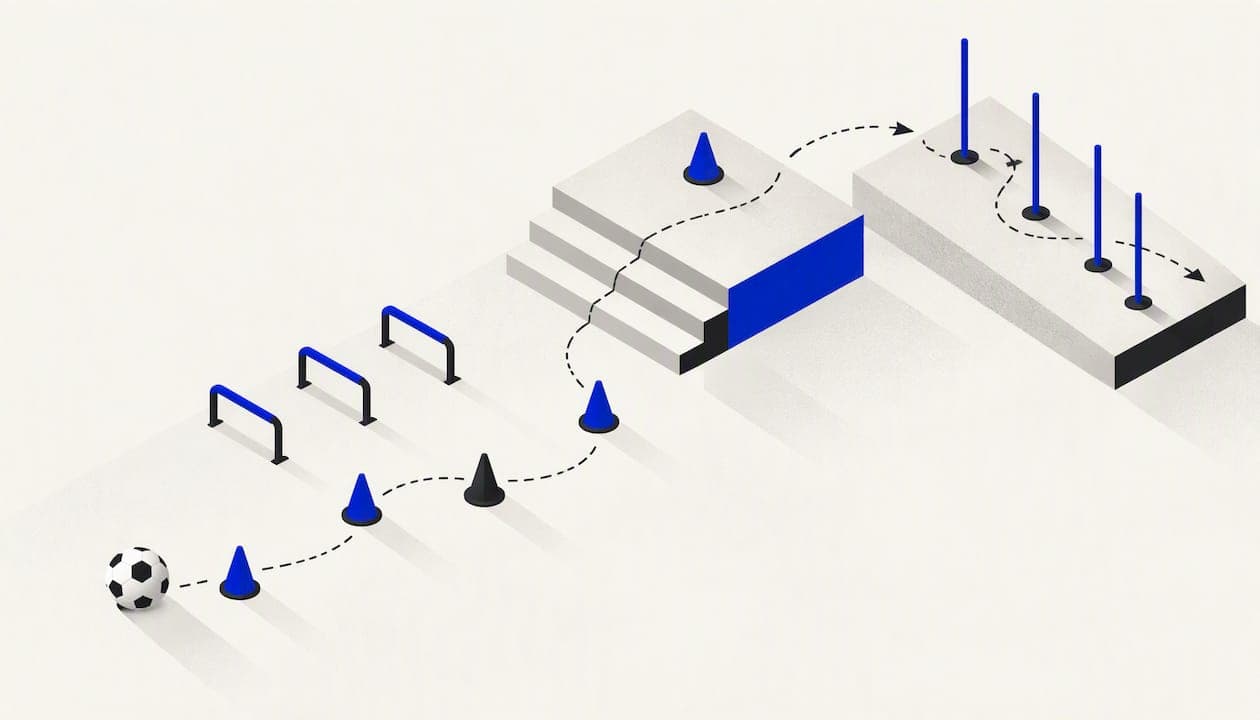
The best soccer agility drills do two things: they teach your body to accelerate, brake and turn cleanly, and they force you to react to a ball, a teammate or an opponent. Cones and ladders cover the first part. Cues, a ball and a live defender cover the second. Below you will find eight drills with exact setups, ways to make each one harder, sensible sets and rest, and how to fit it all into a normal training week.
TL;DR
- Agility in soccer is a response to a stimulus, so pre-planned cone drills are the foundation, not the finish line.
- Start every session with a proper warm-up, then do agility work while you are fresh and before heavy fatigue sets in.
- Two short sessions a week, with at least 72 hours between jump-heavy sessions, is a well-supported starting point for young players.
- Add a ball, a signal or a defender to each drill once the footwork is clean.
- Change the demands by age, position and space: younger players need games, wide players need more turning and braking.
Table of Contents
- What agility means on a soccer field
- Warm up before any agility work
- Eight soccer agility drills
- Add a ball, a cue or a defender
- Adapt the drills to age, position and space
- How many sets, reps and sessions
- Common mistakes to fix
- Our perspective: feedback is the missing piece
- Get coach-style feedback on your agility work
- FAQ
- Sources
What agility means on a soccer field
Most people picture agility as fast feet through a ladder. The research describes something broader. A 2022 review in the NSCA's Strength and Conditioning Journal defines agility as rapid whole-body movement with a change in velocity or direction in response to a stimulus, combining visual scanning, anticipation, decision-making and motor control. The same authors argue that pre-planned acceleration, deceleration and cutting are necessary foundations, but that match agility only appears when perception and decision-making are coupled to movement.
FIFA's Professor Warren Young makes a similar point: effective agility development combines movement technique, physical strength and power, and the ability to anticipate opponents and read the game. In matches, attackers use agility to outmaneuver defenders and create openings, while defenders use it to close space and win the ball.
That has a practical meaning for your training. A drill where you know the route in advance builds technique and power. A drill where you choose the route builds the skill you actually use on game day. You need both, in that order.
It also helps to know that agility and pre-planned change of direction are not the same thing. A study of 14 national-level youth players found they were distinct abilities, and that performance dropped sooner in repeated agility trials than in repeated change-of-direction trials. So a player who looks fast on a cone course may still struggle when the direction is decided in the moment.

Does it work?
A 2025 meta-analysis of nine studies with 498 soccer players found that speed, agility and quickness training had significant effects on sprint performance, change-of-direction ability, power and change-of-direction dribbling, but not on flexibility. In short, structured agility work improves the movements that decide duels, so it earns a place in your week.
Warm up before any agility work
Agility drills load your ankles, knees and hips with sudden braking and cutting. Never start them cold. A simple ten-minute sequence is enough:
- Two to three minutes of easy jogging, mixing in side shuffles and backpedaling.
- Dynamic movements: leg swings, walking lunges with a twist, high knees, butt kicks.
- Three or four progressive runs at 60, 70 and 80 percent effort over about 15 yards.
- A few practice cuts at half speed, planting the outside foot and pushing off.
If you include jumping or hopping drills, put them after the warm-up. The systematic review of youth plyometric training also stresses qualified supervision, technically correct landing and jumping mechanics, and grass or turf surfaces to manage injury risk. If a young player has a current knee or ankle problem, check with a doctor or physical therapist before adding this work.
Eight soccer agility drills
Distances below are practical setups we suggest, not fixed standards. Shrink or stretch them to match your space and level. Quality beats speed: if your form falls apart, slow down or rest.
1. Sprint, brake and backpedal
Set three to five cones in a line, about 5 to 7 yards apart. Sprint to the first cone, brake in a low, balanced stance, backpedal a few steps, then turn and burst toward the next cone. Keep your chest over your knees as you decelerate.
Coaching point: the braking step is the skill. Short, quick steps into the stop keep you balanced and ready to go again.
2. Deceleration shuttle
Place two cones 15 yards apart and add a cone at 5 yards from each end. Sprint to the first cone, brake, circle it, accelerate to the next and repeat. Alternate clockwise and counterclockwise rounds so both legs take turns pushing off.
Coaching point: the turn is where most players lose speed. Drop your center of gravity, take small, light steps into the turn, and lean forward as you accelerate out.
3. Five-cone zigzag
Set five cones in a zigzag, with each cone about 4 yards forward and 3 yards to the side of the previous one. Sprint to each cone and cut around it, planting with the outside foot. Jog back and repeat.
Coaching point: plant, push, and look up. Cutting with your eyes on the cone only rehearses a track, not a game.
4. Lateral shuffle box
Mark a 5-yard square. Sprint forward to the top-right cone, shuffle across to the top-left, backpedal to the bottom-left, then shuffle back to the start. Keep your feet from crossing and your hips low.
Coaching point: change direction without standing up. Staying low shortens the time you spend slowing down.
5. Ladder footwork
Use an agility ladder or eight to ten flat markers in a line. Rotate through one foot per box, two feet per box, lateral two-footed steps and a hopscotch pattern. Start slowly and speed up only when each pattern is clean.
Coaching point: ladders train rhythm and foot contact, which is useful for football footwork, but they involve no decisions. Treat them as technique work and pair them with a ball or a cue later in the session.
6. Weave in, weave out
Place six markers about 3 yards apart in a line, then offset a second row so you can sprint between them. Use quick side steps rather than stopping and turning to face each marker. Finish with a sprint of five yards.
Coaching point: think of each step as a small feint. Your hips should lead the change in direction.
7. Follow the leader
In pairs, use an area of around 20 by 20 yards. The leader jogs, sprints, stops and changes direction at random. The follower tries to stay about 2 yards behind. Swap roles every few minutes.
Coaching point: this is the simplest reactive drill, and it needs no equipment. The follower cannot predict the route, so the drill trains perception and response together.
8. Mirror and react in a gate
Mark two cones 5 yards apart as a gate. An attacker moves side to side along the line while a defender mirrors from a metre or two away, staying side-on and balanced. On a signal, the attacker sprints through the gate and the defender closes.

Coaching point: FIFA grassroots coaching advises defenders to stay side-on and compact and show attackers away from goal, while attackers use feints, changes of direction and changes of pace.
Add a ball, a cue or a defender
Once the footwork is clean, make every drill less predictable. This is how a cone exercise turns into football agility training.
Reaction cues. Coach signals can be auditory or visual, and the NSCA lists variations such as different starting stances, multiple balls, or numbered or coloured balls. In one of its drills, the athlete chops the feet while watching for a visual direction cue, so the decision cannot be made in advance. You can copy this at home: have a friend point left or right at the last moment.
Command changes of pace. In a FIFA elite session on ball control, coach Mauricio Marques has players dribble freely on the command "Pace," then respond to "Change" with a faster controlled dribble and quick direction changes while avoiding collisions. He views a quick change of direction as comparable to a feint: close control plus a burst of acceleration to evade an opponent or move into space.
Pairs and passes. The same session progresses to pairs, where the receiver changes direction immediately before receiving a pass, simulating an attempt to lose a marker. Try it with the zigzag drill: finish the last cut and receive a pass from a partner.
Colour commands. FIFA's 2026 session with NEC Nijmegen's U21s uses a reaction competition: three courses, each with a mini-goal and three cones. A command names a cone colour, players sprint around that cone and pass into goal, and the first scorer earns a point. It is easy to adapt with any three cone colours and a small goal.
Coaching points for ball-based agility:
- Keep the ball close as you change direction.
- Scan with your head up between touches.
- Accelerate immediately after the turn.
- Treat a quick cut as a feint to evade pressure.
Adapt the drills to age, position and space
By age
England Football's coaching guidance identifies agility, balance and coordination as fundamental movement skills, alongside running and jumping, and football-specific actions such as jockeying, spinning and twisting with the ball. For ages 5 to 11 it recommends game-like, fun activities, then building toward football-specific movement and strength from age 12.
The NSCA review adds a caution about early specialization: before age 13, diversified games, tag, evasion and partner-follow activities, plus exposure to other sports, can build movement variability and reduce repetitive stress. For a nine-year-old, follow the leader beats a timed cone course every time.
By position
Different roles produce different demands. England Football suggests varying positions and match contexts, noting that wide players may accelerate, decelerate and turn more than centre-backs. A winger can spend more time on braking and cutting with the ball. A center-back might spend more on backpedaling, side-on mirroring and short bursts. A midfielder benefits most from scanning and turning under pressure.
By space
| Space available | Good choices |
|---|---|
| Living room or small yard | Ladder footwork, mirror drills with a partner, small-area ball touches |
| Driveway or half a basketball court | Lateral shuffle box, weave in and out, cue-based drills |
| Full field | Sprint-brake-backpedal, deceleration shuttle, zigzag with a pass, gate drills |
You can also change time limits and rest. England Football notes that players with disabilities might need extra support, such as longer rest periods.
How many sets, reps and sessions
There is no single perfect prescription, but the research gives useful guardrails. Agility work is demanding on the nervous system, so keep volume modest and quality high.
For drills that involve jumping or hopping, the systematic review of youth plyometric training recommends 2 sessions per week for 8 to 10 weeks, with 72 hours between sessions. It suggests starting with 50 to 60 foot contacts and capping each session at 80 to 120 contacts, using 3 to 4 exercises for 2 to 4 sets of 6 to 15 repetitions. Ladder hops and lateral hops count toward your contacts, so keep a rough tally.
For running drills such as the shuttle or zigzag, a practical starting point is:
- 4 to 6 repetitions per drill, alternating directions.
- About 10 to 20 seconds of rest between short repetitions, and 1 to 2 minutes between drills.
- 3 to 4 drills per session, no more than 20 to 30 minutes of focused work.
Because performance declines sooner in repeated agility trials than in pre-planned ones, stop a reactive drill when your decisions or form slow down, not when you feel completely tired.
A sample week
| Day | Focus |
|---|---|
| Monday | Warm-up, sprint-brake-backpedal, zigzag, ladder footwork, then a ball drill |
| Wednesday | Team training or rest |
| Thursday | Warm-up, deceleration shuttle, weave in and out, follow the leader, small-sided game |
| Weekend | Match or rest |
If your age group has matches on the weekend, keep Thursday's volume low so you arrive fresh.
Common mistakes to fix
- Standing tall in the turn. Lower your hips before you plant. Tall turns are slow and risky for the knees.
- Rushing the ladder. A fast, sloppy ladder teaches nothing. Clean and slow, then faster.
- Looking only at your feet. Match agility depends on scanning. Raise your head between touches.
- Always turning the same way. Alternate directions so both legs learn to push off and brake.
- No reaction element. If every drill is pre-planned, add a cue, a ball or a live partner in the last third of the session.
- Training tired. Do agility work early in the session. Quality drops quickly with fatigue.
Our perspective: feedback is the missing piece
Most players who work on agility alone have the same problem: they cannot see what their body is doing. You run the cone course, feel fast, and have no idea whether your plant foot was too wide, your hips were too high or you looked down on the turn. A coach standing beside you would catch that in seconds.
That is why we built Velora around feedback, not just drill lists. We believe training should match your position, your level and your goals, and that video of your own movement, reviewed frame by frame, is the quickest route to better technique. A winger and a center-back should not follow the same plan, and a beginner should not copy a pro's volume.
We also believe consistency beats intensity. Two focused sessions every week for months will do more than one heroic session a month. That is why we pair weekly plans with streaks and achievements, so the habit survives the weeks when motivation fades.
— User
Get coach-style feedback on your agility work
If you want these drills built into a weekly plan for your position, Your AI football coach reviews the videos you submit frame by frame, grades your progress and adjusts your training plan as you improve. You can learn more on the Playvelora home page.
FAQ
How often should I do agility drills for soccer?
Two short sessions a week is a sensible starting point. For jump-based work, research on youth players supports two sessions per week for 8 to 10 weeks with 72 hours between sessions. Fit them on non-match days and keep each focused block to roughly 20 to 30 minutes.
Do ladder drills actually improve agility?
Ladders build rhythm, foot contact and coordination, but they have no decisions in them, so they only cover part of agility. Use them as technique work, then add a ball, a cue or a defender so the footwork is tested under game-like conditions.
What are the best football footwork drills I can do at home?
In a small space, try ladder patterns (or tape lines on the floor), a lateral shuffle box and a mirror drill with a family member. Add small-area ball touches, and have your partner point left or right at the last second to make it reactive. Always warm up first and use a non-slip surface.
At what age should kids start agility training?
Children aged 5 to 11 benefit most from playful games that build agility, balance and coordination, such as tag and follow the leader. From around 12, football-specific movement and strength work can be added gradually. If a child has pain or a past injury, ask a pediatrician or a qualified coach first.
Sources
- Warren Young on the science of agility, FIFA Training Centre
- Polonia Warsaw: Quiet coaching, joy and 1v1 development, FIFA Training Centre
- Multidirectional Speed in Youth Soccer Players, NSCA Strength and Conditioning Journal
- How to develop your players' movement skills, England Football Learning
- Mauricio Marques: Ball manipulation and control, FIFA Training Centre
- NEC Nijmegen U-21s session, FIFA Training Centre
- 5 Reaction Drills to Build Quickness, NSCA
- Plyometric Training Effects on Athletic Performance in Youth Soccer Players, PubMed
- Agility and change-of-direction speed are two different abilities, PMC
- Effects of speed, agility, and quickness (SAQ) training on soccer players, PMC