
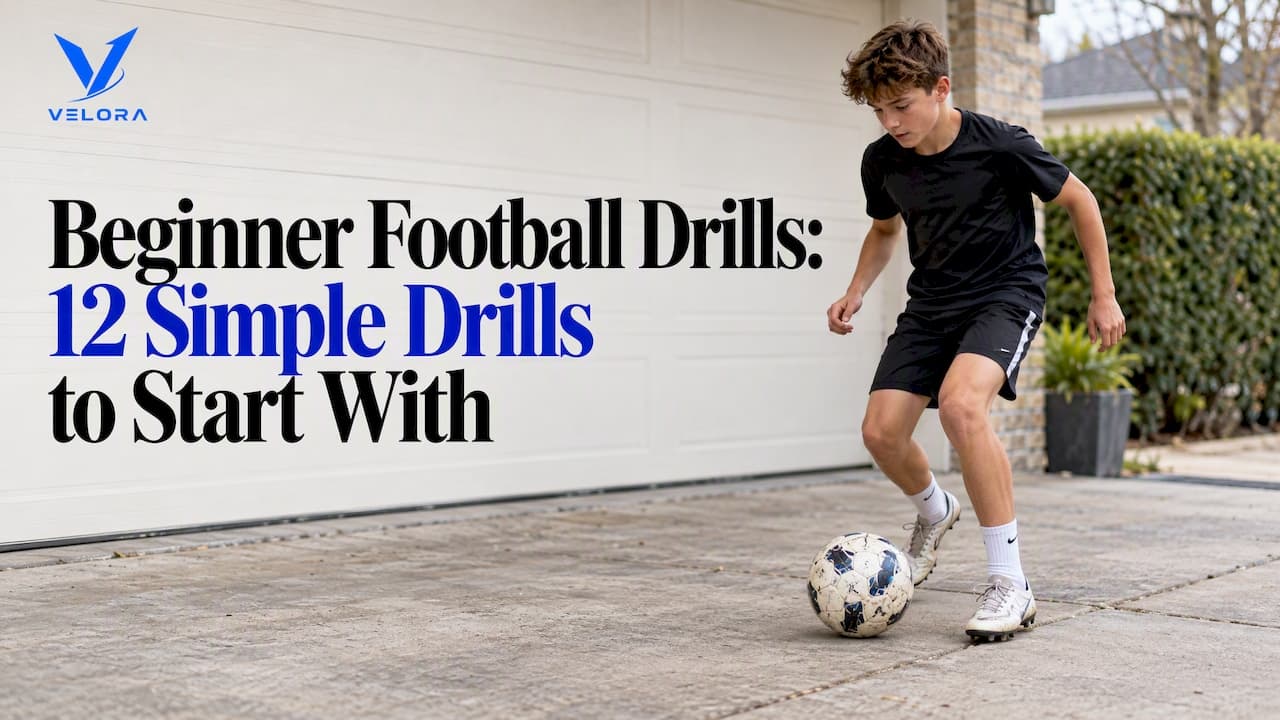
The best beginner football drills are simple ones you can repeat often: dribbling in open space, passing against a wall or with a partner, light-touch cone work, and small games. This guide covers soccer, which most of the world calls football, with a short section at the end for beginners in American football. You will find drills for training alone, with a partner and in a group, plus a weekly plan that fits around school or work.
TL;DR
- Start with three skills: dribbling, passing and shooting. Everything else builds on them.
- Short, frequent sessions with lots of touches beat one long, tiring workout.
- You can train alone with a ball, a wall and some open space. Cones help but are optional.
- Young beginners need practice that is fun, active and age-appropriate. Games should make up a big share of the session.
- Add difficulty only after the current drill feels easy: more speed, then a weaker foot, then a defender.
Table of Contents
- What beginners should work on first
- How to build a beginner session
- Dribbling drills for beginners
- Passing and receiving drills
- Shooting drills
- Agility and footwork drills
- How to practice football alone
- Drills with a partner or small group
- Adapting drills for young beginners
- A simple weekly plan for beginners
- Our perspective
- Get feedback on your drills
- Beginner drills for American football
- FAQ
- Sources
What beginners should work on first
A new player does not need fancy skills. The basics come first: controlling the ball, dribbling, passing and shooting. Canada Soccer's coaching toolkit for new players recommends building a foundation in controlling, dribbling, shooting, fakes, turns and passing. It also stresses plenty of touches, quick decisions and small-sided games.
Under Armour's soccer skills guide names dribbling, passing and shooting as the three basic skills and suggests beginners start dribbling in open space with the inside and outside of both feet. The same guide advises repeating a drill, then adding one new element once you have mastered the current level.
That last point is the whole method. Pick a drill, repeat it until it is comfortable, change one thing, repeat again.
How to build a beginner session

The Canada Soccer toolkit gives a useful template. It splits a session across four pillars: general movement, coordination, soccer technique and small-sided games. Its template gives 20% to each of the first three and 40% to games.
For a 60-minute session, that looks like this:
| Block | Share | Minutes | Example |
|---|---|---|---|
| Movement | 20% | 12 | Jogging, skipping, changes of direction with a ball |
| Coordination | 20% | 12 | Toe taps, ladder steps, juggling attempts |
| Technique | 20% | 12 | Passing against a wall, cone dribbling |
| Games | 40% | 24 | 3v3 or 4v4 |
Training alone, you cannot play a real game, so swap the last block for a challenge: how many wall passes in a row, how many cones without touching one, how many shots on target out of ten.
Dribbling drills for beginners
Dribbling is where most new players should spend their first weeks. It teaches you to keep the ball close, and it makes every other skill easier.
1. Open-space dribbling
Find a patch of grass or a driveway. Dribble slowly with the inside and outside of your right foot, then your left. Keep your head up every few touches. Walk first, jog later. This is the same starting point Under Armour recommends: open space, both feet, inside and outside.
2. Toe taps and inside-outside touches
Stand with the ball in front of you and tap the top of it alternately with each foot. Then roll it side to side between the insides of your feet. A youth soccer technique guide lists toe taps, inside-outside touches, sole drags and juggling as ways to build coordination, agility and familiarity with the ball. You can do these in a space the size of a doormat.
3. Straight-line cone dribble
Set five to eight cones in a line, about 2 meters (roughly 6.5 feet) apart. One beginner drills guide suggests using both feet with light touches and spending 10 to 15 minutes before making the drill harder. No cones? Use water bottles, shoes or sticks.
4. Zigzag weave
Once the straight line is easy, offset the cones and weave through them. Use the inside of one foot, then the outside of the other. Slow and clean beats fast and sloppy. If you want more variations and progressions, our guide to football dribbling drills lays out seven sessions that build control step by step.
Passing and receiving drills
5. Wall passes
Stand about 5 feet from a wall. Under Armour's guide describes passing at a wall from that distance, aiming at a target, varying the power and trying to get the ball to return to the same spot. Use the inside of your foot, plant your other foot beside the ball, and follow through toward the target.
Progress like this:
- Right foot only, ten passes, stop the ball each time.
- Left foot only, ten passes.
- Alternate feet.
- Move back a step and pass harder.
- Control the rebound with one touch and pass again without stopping it.
6. Paired passing
With a partner, stand 5 to 10 yards apart and pass with the inside of the foot. AYSO's U9/U10 sample sessions include paired passing and emphasize soft touches, inside-foot passing and first touch. Cushion the ball when it arrives instead of letting it bounce off your foot.
7. Pass-and-move triangle
Three players stand in a triangle, about 8 to 10 yards on each side. Pass to a teammate, then move to a new spot and receive again. This adds movement to the passing. The same AYSO sessions use pass-and-move triangles and ask players to receive into the direction of their next pass.
8. Turning receiver with a passive defender
One player passes, a receiver turns away from a defender who only applies light pressure, then passes back. It teaches you to look before the ball arrives. Make the defender active only when the turn is comfortable.
Shooting drills
9. Unguarded shots at a target
Set up a goal, or use two cones or jackets as posts. Place the ball, take a short run-up and strike with the laces or the inside of your foot. Aim for the corners first, power later. Ten shots, count how many hit the target, write it down, beat it next time. Under Armour suggests practicing unguarded shots at a designated area when you are on your own.
10. Pass, control, shoot
Pass the ball against a wall, control the rebound with one touch, and shoot. This links three skills in one flowing movement and feels much closer to a real game than static shooting.
Agility and footwork drills
11. Ladder steps and cone footwork
A ladder, drawn with chalk or laid out with tape, works for quick-feet patterns: one foot in each square, two feet in each, lateral in-and-outs. One small-space training guide notes that ladder footwork and cone weaving make efficient use of limited room. Do them without a ball first, then add the ball once the pattern is automatic.

For a longer menu with progressions and a weekly layout, see our article on soccer agility drills.
12. Juggling
Juggling looks like a trick, but it teaches touch. Let the ball bounce once between touches if you cannot keep it up yet. Count your best streak, aim to add one each session, and use both feet and your thighs.
How to practice football alone
You need less than you think: a ball, a wall and open space. Under Armour's guide says a beginner can practice open-field dribbling, wall touches and unguarded shots at a designated area.
A 30-minute solo session might be:
- 5 minutes: toe taps and inside-outside touches
- 8 minutes: cone or bottle dribbling, both feet
- 10 minutes: wall passes with right foot, left foot, then alternating
- 5 minutes: shots at a target
- 2 minutes: juggling for a new personal best
The hard part of training alone is knowing whether you are doing it right. Nobody tells you your plant foot is too far from the ball. Filming yourself on a phone helps: watch the clip and compare it with a tutorial from a qualified coach.
Drills with a partner or small group
With friends, switch from repetition to games. AYSO's guidance supports small-sided games such as 3v3 or 4v4 because they encourage movement, communication, quick decisions and many touches. With fewer players on the field, everyone is involved all the time.
Try these:
- 3v3 to small goals. No goalkeepers. Two points for a goal after at least three passes.
- Dribble tag. Everyone has a ball inside a grid. Keep your ball while trying to knock out others, or play a version where the tagger must also dribble.
- Gates game. Scatter pairs of cones as gates. Score a point for each pass through a gate to a teammate.
Adapting drills for young beginners
For parents and coaches, the first rule is that practice should be fun. The FA's Foundation Phase guidance says coaching children should be enjoyable, exciting and very active. It also recommends warm-ups that introduce a wide range of movements and include a ball where possible.
Some practical adjustments:
- Use stations. Canada Soccer's toolkit notes that station-based practice lets players rotate between skill activities and adapts to age, group size, coaches and facilities. Three stations of 8 to 10 minutes each work well for a mixed group.
- Keep groups small. U.S. Soccer's age-appropriate formats list 4v4 for U7-U8 and 7v7 for U9-U10, with training games up to those formats.
- Give every child a ball. Standing in line is the enemy of learning.
- Praise effort, not outcome. A missed turn tried bravely is better than a safe pass.
A simple weekly plan for beginners
Three sessions a week is plenty to start. Mix solo work with at least one session that involves other people.
| Day | Focus | Drills |
|---|---|---|
| Day 1 | Dribbling | Toe taps, straight-line cones, zigzag weave |
| Day 2 | Rest or light juggling | 10 minutes of juggling |
| Day 3 | Passing and receiving | Wall passes, paired passing |
| Day 4 | Rest | |
| Day 5 | Games and shooting | 3v3 or 4v4, shots at a target |
| Weekend | Optional | Free play with friends |
Write down your numbers: wall passes in a row, shots on target, juggling streak. A visible score is the easiest way to see progress and keep going.
Our perspective
We see the same pattern in new players. They start motivated, practice the same two moves for a week, then stall because they cannot tell what to fix. The drills in this article are not the problem. Feedback is.
That is why we built Velora around coach-like feedback. A player films a drill, and the platform analyzes the video frame by frame and gives graded insight on technique, instead of a generic "good job". Training plans follow the player's position, skill level and goals, and a streak and achievement system rewards showing up regularly, which matters more than any single drill.
Our advice to any beginner is the same with or without an app: keep sessions short, repeat the basics until they feel boring, change one variable at a time, and get someone, or something, to look at your technique.
— User
Get feedback on your drills
If you are practicing alone and want to know whether your technique is improving, Your AI football coach is built for that. Upload a clip of your drill, get frame-by-frame feedback and follow a weekly plan matched to your position and level. Parents and coaches can use it to support young players between team practices.
Beginner drills for American football
If you landed here looking for American football, the drills differ, and safety guidance matters more because of contact. Flag football agility work such as cone shuffles and ladders overlaps with the footwork above. Catching, throwing and stance work replace dribbling and passing with the feet.
USA Football's guidance for youth coaches gives clear limits:
- Match practice frequency and duration to athlete development, increasing workload gradually.
- Plan a preseason heat acclimatization period of 10 to 14 days, with practice intensity and equipment added gradually.
- After acclimatization, hold no more than four practices a week in preseason, with full-contact work limited to 30 minutes a day and 120 minutes a week.
- For non-contact, limited-contact or modified tackle programs, start from a two-point stance, because three- and four-point stances typically involve more repetitive head impacts.
The principle is the same as in soccer: technique and decision-making first. USA Football says youth practice should avoid drills with no skill benefit or added injury risk. If your child is starting tackle football, ask the league which of these guidelines it follows.
FAQ
How can I learn football skills as a beginner?
Start with dribbling, passing and shooting, practiced in short sessions several times a week. Use both feet from the first day. Add one challenge at a time, such as more speed or a weaker foot, once the basic version feels easy.
How can I practice football alone?
You need a ball, a wall and open space. Dribble in open space, pass against a wall from about 5 feet away, and take shots at a target. Film yourself occasionally so you can check your technique.
What are the easiest football drills for beginners?
Toe taps, inside-outside touches, straight-line cone dribbling and wall passes are the easiest to learn and need almost no equipment. Each can be done in a small space. Keep them slow until the movement is clean.
How long should a beginner practice?
Thirty to sixty minutes, two or three times a week, is a good start. Young children need shorter blocks with more games and variety. Quality touches matter more than total time.
Sources
- Canada Soccer FUNdamentals Coach's Toolkit
- Soccer Skills, Under Armour
- Guide to Teaching Football Technique
- Top Beginner Football Drills for New Players
- Small Space Football Drills
- AYSO U9/U10 Sample Practice Sessions
- The FA Foundation Phase
- U.S. Soccer age-appropriate formats
- USA Football Youth Practice Guidelines
- USA Football National Practice Guidelines
- USA Football Recommendations for Youth Play